Why hard-pausing "zombie" or zero-conversion SKUs hurts long-term revenue
Across large catalogs with 10,000 to 100,000+ SKUs, consolidated campaigns frequently route significant ad spend to items returning below break-even ROAS.
PPC teams using basic scripts often react by hard-excluding any SKU that spent past a fixed cutoff with 0 conversions over 30 days. Hard exclusion creates a permanent ratchet trap:
- Over 6 months, thousands of catalog items become permanently excluded from Shopping auctions.
- When a supplier lowers wholesale cost, a competitor runs out of stock, or seasonal demand returns, excluded SKUs cannot win impressions.
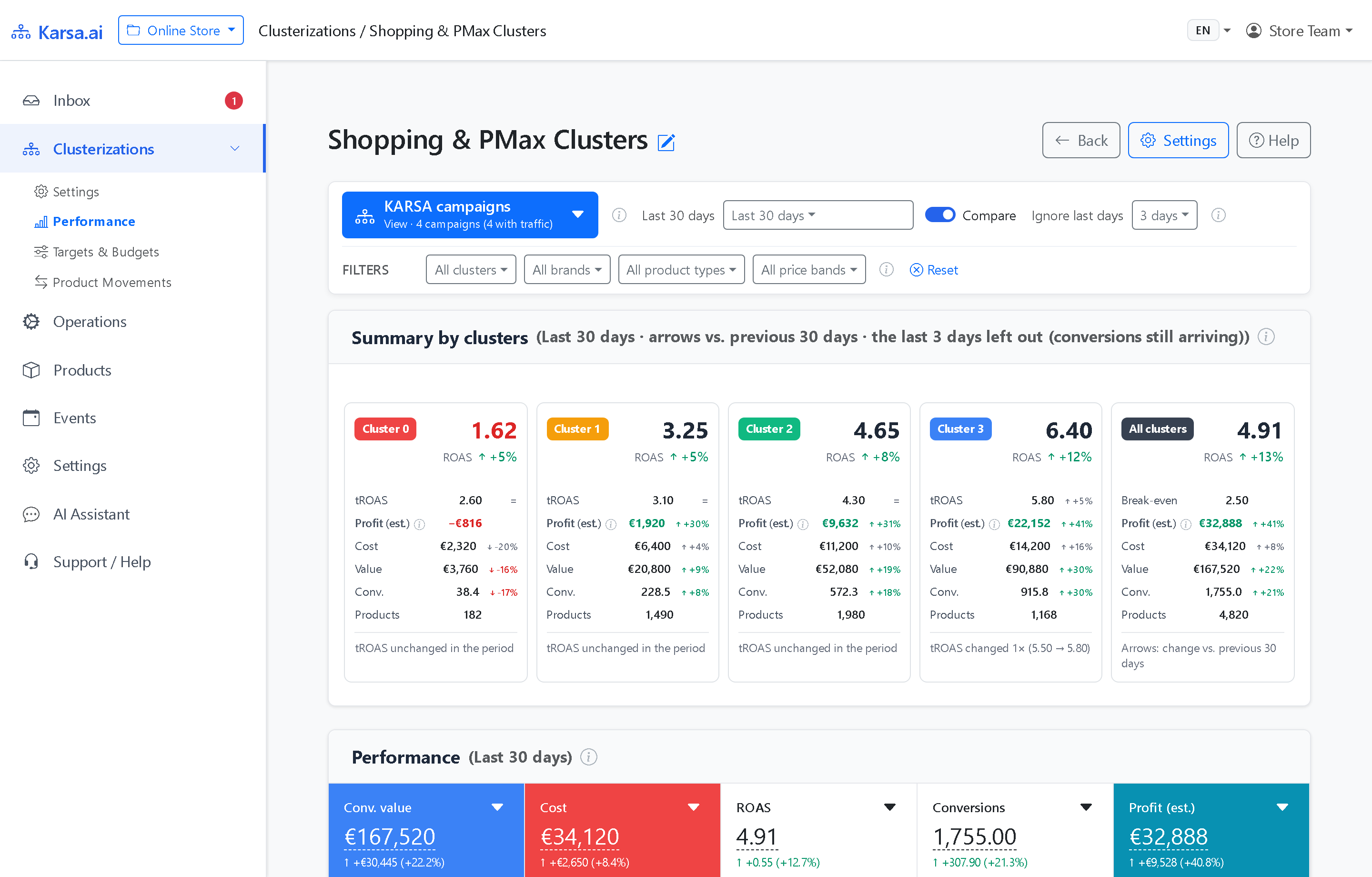
How Karsa.ai’s C0 and C1 isolation works instead
| Cluster | Assigned Products | Recommended Campaign Setup | Result |
|---|---|---|---|
C1 (Low / Borderline) |
Low predicted performance or zero-conversion exploration SKUs | Separate campaign · Break-even+ Target ROAS · Capped daily budget | Controlled discovery without consuming top-cluster budgets |
C0 (Loss-Making) |
Statistically confirmed negative-margin spenders | Separate campaign · Strict protective Target ROAS · Minimal daily budget cap | Losses capped from the next daily sync; SKUs remain live for cheap exact-match clicks |
C0 is optional
C0 is set separately for each clusterization, and it does not pay off in every project. When C0 is off, Karsa.ai assigns these products to the active clusters by their predicted performance, like any other product. The lowest active cluster (C1) with a strict Target ROAS and a capped budget then limits weak products.
Automatic recovery when product economics improve
Because C0 and C1 remain live behind protective Target ROAS bids, Karsa.ai tracks fresh prices and stock every night. Any SKU whose competitiveness or conversion rate recovers promotes back to C2 or C3 without manual unpausing.
Frequently asked questions
Why not exclude zero-conversion SKUs completely from Google Ads?
Hard-excluding SKUs creates a permanent blind spot: when your store lowers the price, restocks popular sizes, or competitors go out of stock, excluded SKUs receive zero impressions and can never recover. Capping C0 with a high Target ROAS stops losses while preserving a recovery path.
How does Karsa.ai distinguish an unprofitable product (C0) from a product that had low impressions?
A product with 3 clicks and 0 conversions is low-data, not proven unprofitable. Karsa.ai’s statistical model evaluates click cost relative to expected order value and margin break-even threshold before classifying a SKU into C0.
Is the C0 cluster required?
No. C0 is an optional cluster for loss-making products. It is set separately for each clusterization, and it does not pay off in every project. When C0 is off, Karsa.ai assigns these products to the active clusters by their predicted performance, like any other product.