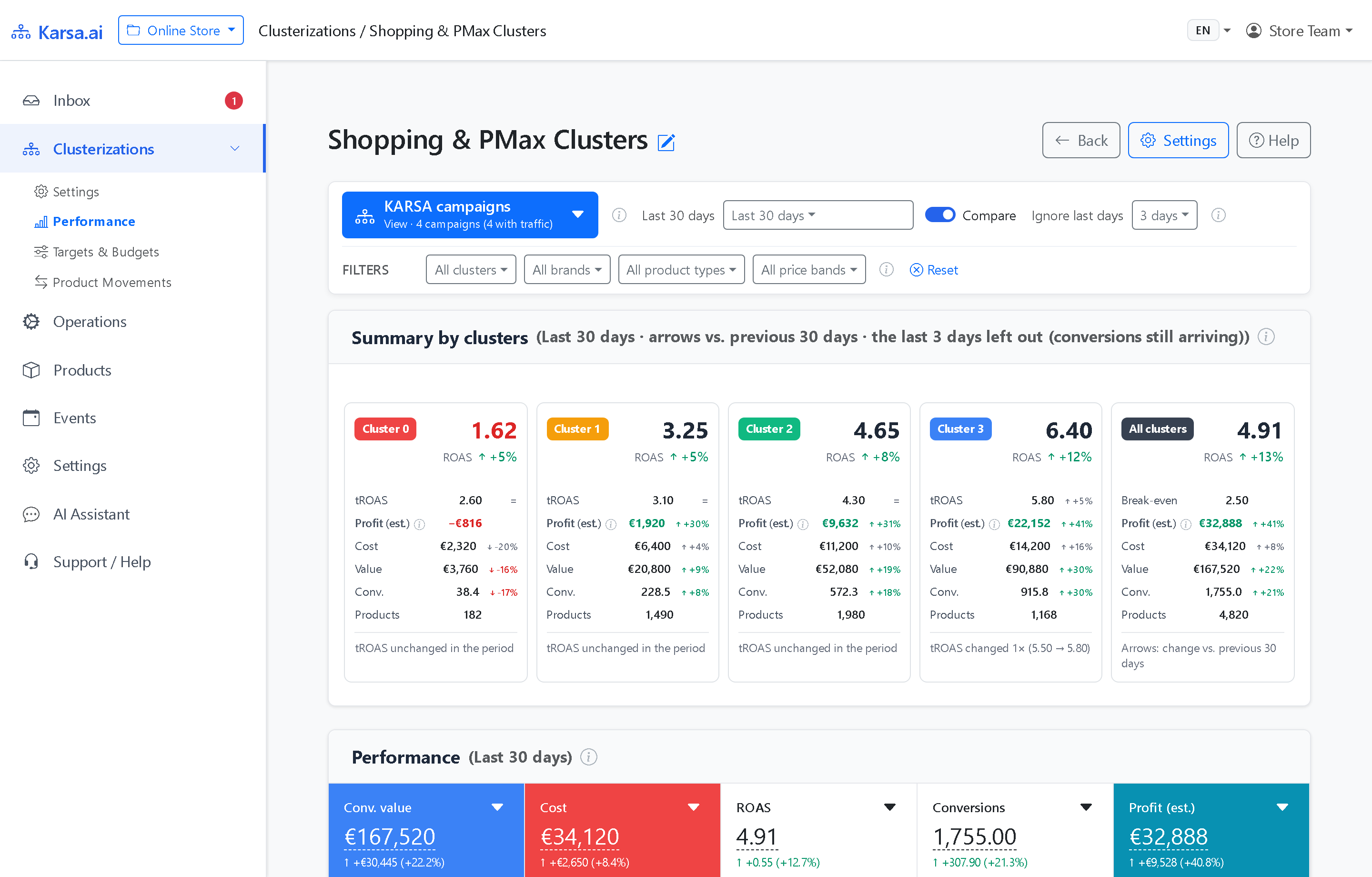
Two flaws in conventional client-side POAS setups
Online stores with variable margins (12% electronics accessories alongside 58% private-label items) rightly want Google Ads optimized for net profit after ad spend rather than raw revenue. However, conventional POAS tag replacements introduce two practical problems:
- IT overhead and conversion history disruption: Building server-side GTM profit pipelines requires engineering sprints and alters historical
Conversion Valueseries inside Google Ads. - One blended POAS campaign still masks SKU-level losses: Even if Google Ads bids toward a
1.40POAS target in one campaign, high-margin bestsellers still offset zero-conversion (C1) and loss-making (C0) SKUs inside that blended campaign average.
How Karsa.ai delivers POAS and net profit optimization with zero tag changes
| Dimension | Client-Side POAS Tag Replacement | Karsa.ai Server-Side Profit + Clustering |
|---|---|---|
| Store IT / GTM Work | Requires server-side GTM & cart profit hooks | Zero store code or tag changes |
| Margin Confidentiality | Risk of margin leakage if done client-side | 100% server-to-server (XML / CSV / API) |
| Google Ads Conversion History | Replaces historical revenue baseline | Preserves native Google Ads revenue 1:1 |
| Loss-Making SKU Isolation | Hidden inside campaign-average POAS | Explicitly separated into C1 and the optional C0 cluster |
How Karsa.ai connects predicted product performance with SKU margins
- Homogeneous clustering: Karsa.ai groups items by predicted product performance (
C1,C2,C3… plus optionalC0) so every campaign holds uniform SKUs. - Exact SKU-weighted Break-Even ROAS: For each cluster, Karsa.ai computes the exact break-even ROAS from the margins of the SKUs currently assigned to that cluster.
- Profit Target Calibration (PTC): Identifies the exact ROAS and daily budget per cluster where marginal spend generates positive net earnings after ad cost.
Frequently asked questions
Why not replace Google Ads conversion value with gross profit in GTM?
Overwriting your primary Google Ads conversion action with custom profit values breaks historical revenue comparability, risks exposing wholesale margins in browser dataLayer payloads unless server-side GTM is built by IT, and still leaves all SKUs mixed inside a single average POAS target.
What happens when a product goes on a 25% sale?
When your XML feed price drops by 25% while wholesale cost stays constant, unit margin shrinks and break-even ROAS rises sharply. Karsa.ai recalculates that SKU’s expected net profit overnight: top products whose conversion rate surges stay scaled, while weak discounted items tighten on the next nightly run.