Where Producthero fits and where PPC specialists outgrow it
Producthero (now part of Channable) helped popularize product-level segmentation in Europe by bundling a Google CSS subscription with its 4-bucket product label segmentation (Heroes, Sidekicks, Villains, Zombies) and title editing tools. For small stores seeking an entry-level CSS bundle and a basic historical split, it provides a straightforward starting point.
Online stores with 1,000 to 500,000+ SKUs, seasonal demand shifts, variable product margins, or dedicated PPC specialists typically outgrow trailing 4-bucket rules for four technical reasons:
- Historical lookback lag: Classifying SKUs by past 30-day clicks and ROAS promotes seasonal bestsellers weeks into peak demand and keeps post-season items in high-budget campaigns after demand drops.
- Threshold boundary oscillation: SKUs hovering near a hard ROAS cutoff flip back and forth between campaigns every few days as individual orders land across conversion-lag windows.
- Hardcoded 4 buckets: Every store is placed into 4 buckets regardless of whether the account generates 120 or 15,000 monthly conversions.
- No server-side margin, PTC, or causal audit layer: Basic historical buckets do not calculate per-cluster break-even ROAS from wholesale COGS, simulate target changes on 60-day SKU distributions, or isolate net lift via Difference-in-Differences.
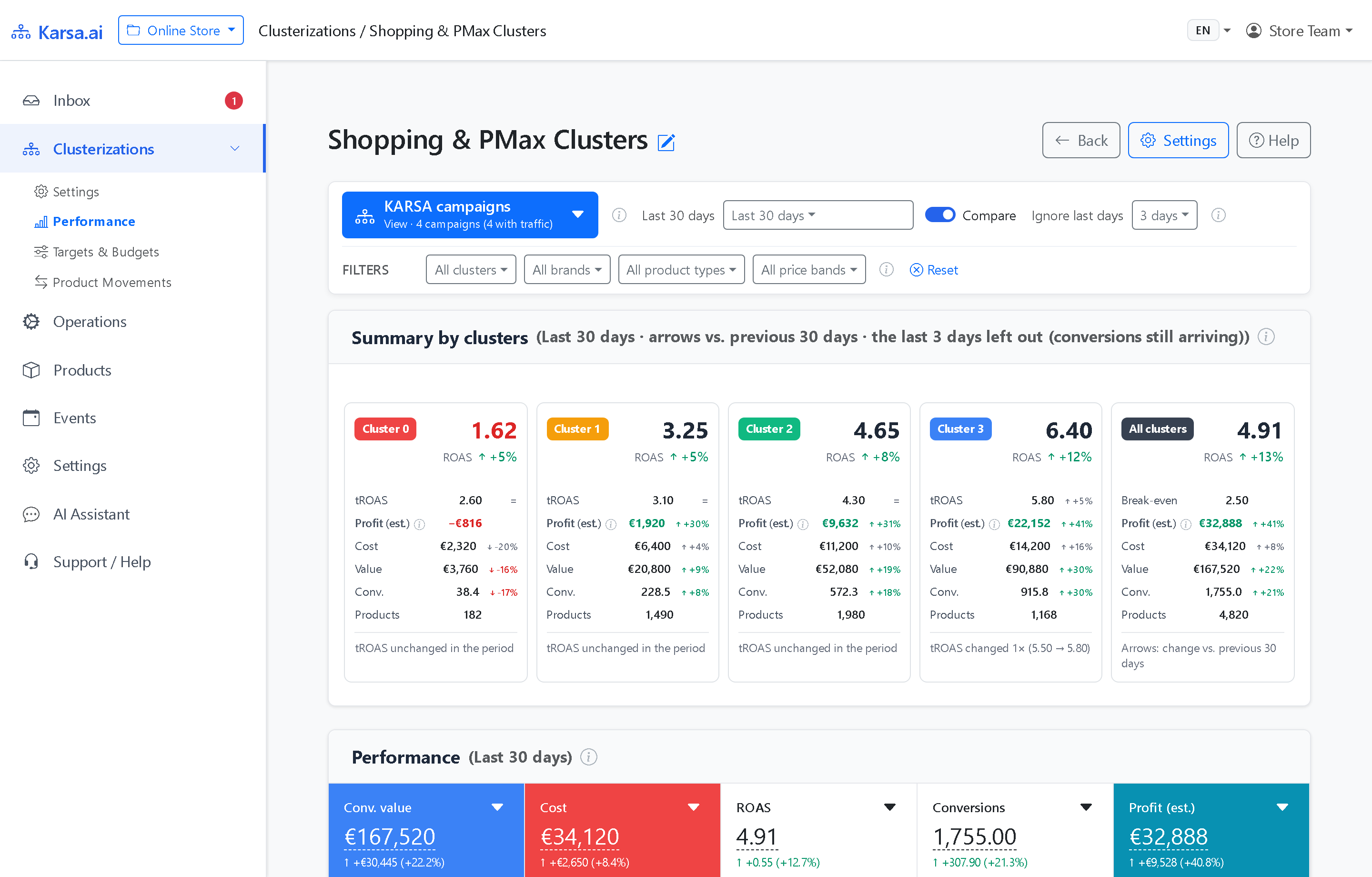
Architectural comparison: Karsa.ai vs. Producthero
| Capability | Karsa.ai | Producthero (Channable) |
|---|---|---|
| Core Segmentation Method | Nightly ML prediction of product performance per SKU | Trailing historical rules (Heroes, Sidekicks, Villains, Zombies) |
| Number of Clusters | Adapted to conversion volume (≥30 conv / 30d per active cluster, optional C0); supports multiple independent clusterizations per account |
Fixed 4 label buckets |
| Daily Movement Stability | Fluidity Manager controls moves (31%–51% fewer daily moves on production stores) |
Hard rule cutoffs susceptible to boundary oscillation |
| Profit & Margin Modes | 5 server-side modes (g:cost_of_goods_sold, CSV margins, Google Ads gross profit, Global Margin %, Conversion Value) |
Primarily revenue ROAS (unless custom external POAS feed is built) |
| Target ROAS & Budget Analytics | Profit Target Calibration (PTC) + 60-day target simulator + ±14d Google Ads change audit + Search IS impact |
Basic bucket reporting without target-reaction or DiD causal audit |
| Google CSS Lock-In | None: works with Google Shopping or any third-party/agency CSS | Bundled with Producthero CSS / Channable plans (producthero.com/pricing) |
| Google Ads Access | Supports Read-only Google Ads user access; does not modify live bids or budgets | Google Ads account connection for historical performance metrics |
| Published Pricing | €164 / €248 / €328 per month billed annually (€205–€410 monthly), 0% ad spend fee, 30-day free trial |
Google Premium CSS €29/mo (first shop); CSS Pro Plan (with automated product segmentation) €99/mo (first shop; additional-shop fees per producthero.com/pricing) |
Keeping your existing CSS partner while upgrading segmentation
Switching Comparison Shopping Service providers across client accounts creates unnecessary admin work for agencies and retail teams. Karsa.ai runs via a Merchant Center supplemental XML feed (<g:id> + <g:custom_label_X>), keeping your current CSS partner and Google Ads bidding untouched.
Sources and verification
Verified on November 13, 2026 against live primary vendor pages:
- Plans, Channable availability (
€29/moPremium CSS,€99/moCSS Pro with product segmentation): https://www.producthero.com/pricing - Google CSS 20% auction margin & CSS setup: https://www.producthero.com/google-css
- CSS Pro product-segmentation buckets (
Heroes,Sidekicks,Villains,Zombies): https://www.producthero.com/pro
Trademarks belong to their respective owners; reach us via our contact form if any vendor specification changes.
Frequently asked questions
Do we lose the 20% European CSS auction advantage if we use Karsa.ai instead of Producthero?
No. The 20% Google Shopping auction margin effect in European Economic Area markets is a standard mechanism of Google’s Comparison Shopping Service (CSS) program rather than a proprietary feature of one vendor. With Karsa.ai, you keep your existing certified CSS partner or agency CSS while Karsa.ai delivers nightly custom_label values via a Merchant Center supplemental XML feed.
Why does a fixed 4-bucket split (Heroes, Sidekicks, Villains, Zombies) underperform on seasonal or mid-sized catalogs?
First, trailing 30-day rules wait weeks after a seasonal surge or price change before reclassifying a SKU. Second, a hardcoded 4-bucket split ignores store conversion volume: smaller stores end up with campaigns below 30 conversions per 30 days, while large 80,000-SKU stores cannot separate elite top performers from mid-tier items.