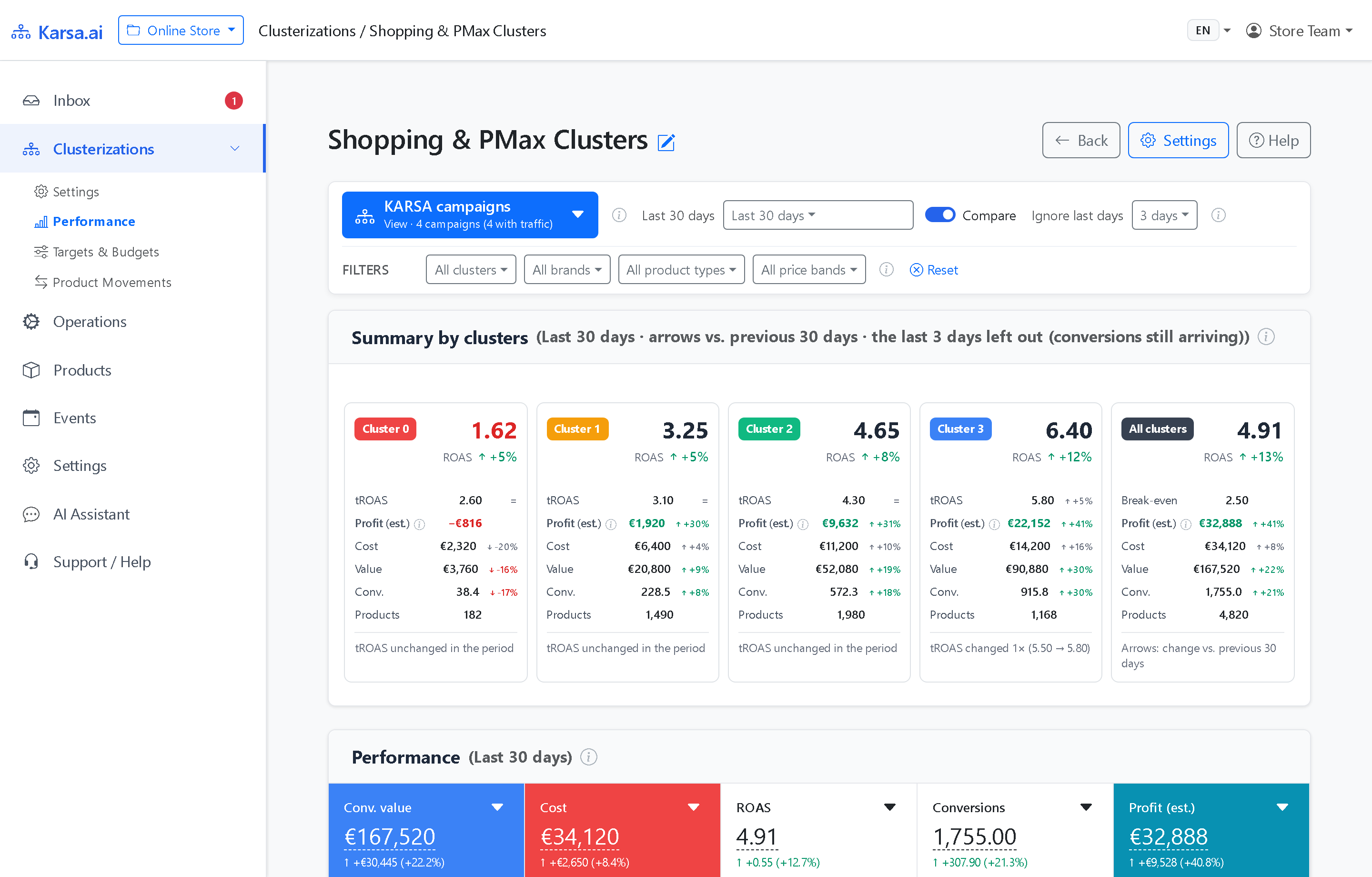
- Profit Target Calibration (PTC) aligns ROAS goals across productive clusters while respecting break-even floors.
- Difference-in-Differences (DiD) clusterization evaluator uses 180 days of history with seasonal adjustment and MDE.
- Engine 9.0 & 9.2: supports up to 12 cluster campaigns, calm scoring on zero-order SKUs, and post-move locks.
- Sub-second clusterization creation via API (677 ms), 5-step Production Go-Live checklist, and automatic Merchant Center XML export.

1. Predictive Engine 9.0 & 9.2: cluster homogeneity and up to 12 campaigns
During June and July 2026 we shipped Predictive Engine 9.0 followed by 9.2, focused on internal cluster homogeneity and scalable campaign structures:
- Up to 12 campaigns: Supports larger multi-category stores across active clusters plus optional
C0when conversion volume justifies finer splits. - Calm zero-order SKU scoring: Sparse and no-sale items remain steady across nightly runs without random flips, backed by post-move locks.
- Sub-second API creation: Backend optimization cut the clusterization setup endpoint from
120sdown to677ms(177×faster).
2. Profit Target Calibration (PTC) with productive ROAS hierarchy
Segmentation only delivers its full return when each campaign carries an appropriate Target ROAS. Profit Target Calibration (PTC) brings structured statistical support to bidding decisions:
- Coordinated hierarchy: Keeps Target ROAS ordered across productive clusters (
C2up to the top group) while respecting entryC1and optionalC0roles. - Pre-computed edit verification: Evaluates target adjustments across a two-month baseline and two-week follow-up window (omitting incomplete recent dates) alongside Approve / Reject controls.
- Go-Live checklist & automatic XML export: Switching a clusterization to Production opens a five-item readiness warning and generates your hosted Google Merchant Center supplemental feed.
3. Causal Difference-in-Differences (DiD) clusterization evaluation
To give finance leads and PPC directors statistical proof rather than raw before-and-after snapshots, July expanded the Difference-in-Differences (DiD) Impact Evaluator:
- Uses 180 days of prior history with Minimum Detectable Effect (MDE) confidence bands and post-launch learning exclusion.
- Adjusts against control campaign traffic so stores measure net segmentation lift accurately across seasonal demand swings.
Karsa.ai Portal views in this release
Click any screen below to inspect the full-resolution portal interface.

Frequently asked questions
Why should Target ROAS be coordinated across productive clusters instead of edited in isolation?
Productive clusters from C2 upward form an ordered bidding hierarchy, while entry group C1 and optional C0 stay exempt. PTC evaluates the full setup together so productive targets keep logical spacing above break-even.
How does Karsa.ai measure net clusterization lift when market demand rises or falls seasonally?
Raw before-and-after totals confuse seasonal peaks with software lift. Karsa.ai's Difference-in-Differences (DiD) clusterization evaluator uses 180 days of history, non-Karsa control traffic, and Minimum Detectable Effect (MDE) bands to isolate net impact.